Concrete Calculator
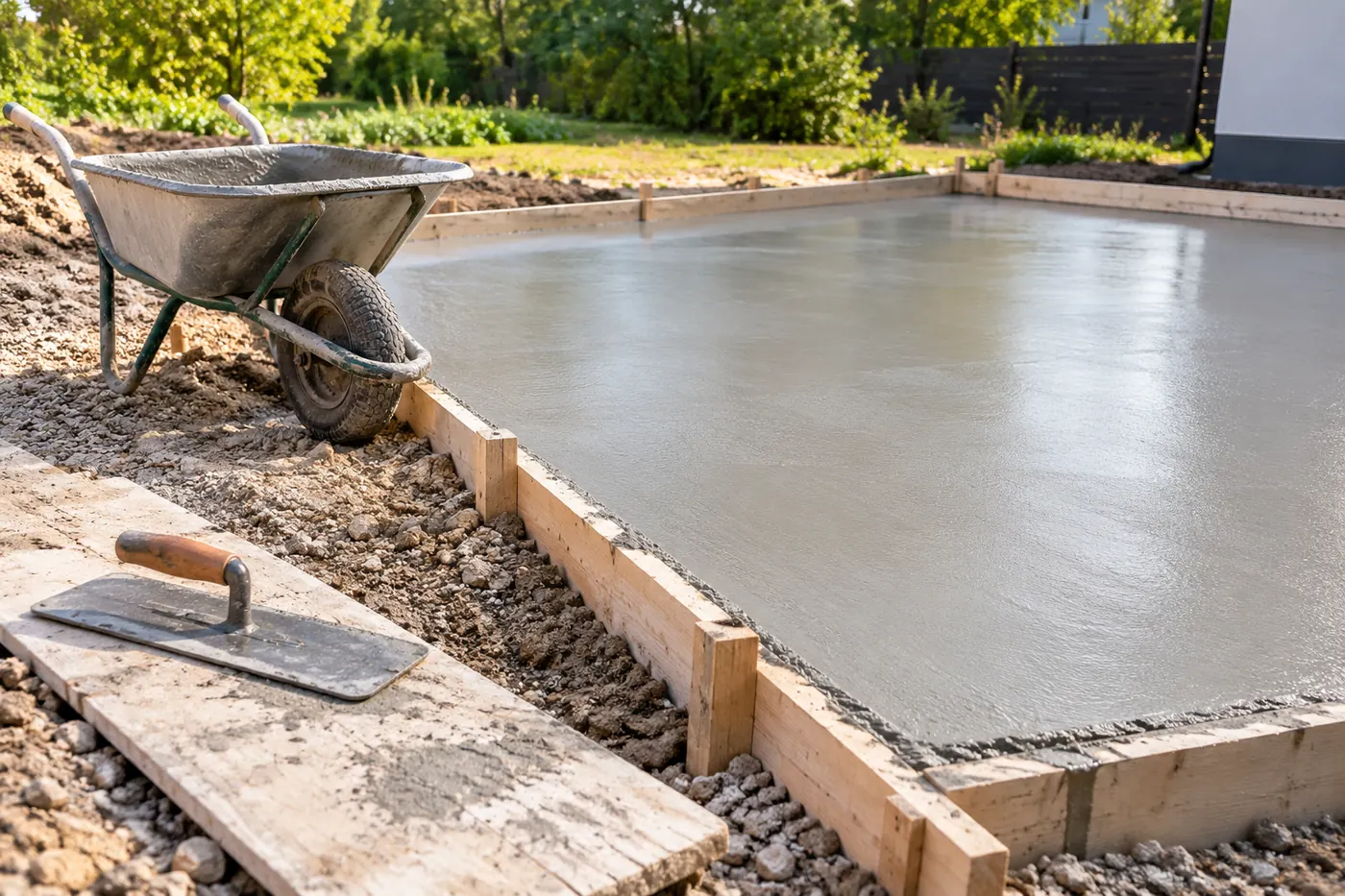
Estimate the concrete for a rectangular slab, patio, or sidewalk. Enter length, width, and depth, each with its own unit in feet or inches. Length and width start in feet. Depth starts in inches, so a 4-inch slab is not treated as 4 feet. The page shows cubic feet, cubic yards, and cubic meters, each rounded from the exact volume. Add an optional waste percent, and type a bag yield only if you want a whole-bag count. This is a materials estimate only, not a structural or building-code specification.
How it works
Estimate the concrete for a rectangular slab, patio, or sidewalk. Enter length, width, and depth, each with its own unit in feet or inches. Length and width start in feet. Depth starts in inches, so a 4-inch slab is not treated as 4 feet. The page shows cubic feet, cubic yards, and cubic meters, each rounded from the exact volume. Add an optional waste percent, and type a bag yield only if you want a whole-bag count. This is a materials estimate only, not a structural or building-code specification.
Worked example
A 10 ft by 10 ft slab at 4 inches thick is 10 × 10 × (4/12) = 100/3 = 33.333… cubic feet, which displays as 33.33. Cubic yards are (100/3)/27 = 1.234567901…, which displays as 1.23. Cubic meters are (100/3) × 0.028316846592 = 0.9438948864…, which displays as 0.94. Waste is 0, so there is no second quantity, and the bag yield is empty, so there is no bag line. The same length and width with a depth of 4 feet (not 4 inches) would be 400.00 cubic feet, 14.81 cubic yards, and 11.33 cubic meters. That is a different pour.
Formula
Convert each side to feet (inches ÷ 12). exact cubic feet = length × width × depth. Display cubic feet = round half-up to 2 decimals (exact cubic feet). Display cubic yards = round half-up (exact cubic feet / 27). Display cubic meters = round half-up (exact cubic feet × 0.028316846592). If waste > 0, withWaste = exact cubic feet × (1 + waste/100), then round yards and meters from withWaste, not from a rounded display. If a bag yield is entered, bags = ceil(order cubic feet / yield), where the order volume is withWaste when waste > 0 and the exact slab otherwise. Volumes are half-up to 2 decimals; bags round up to a whole bag.
Materials disclaimer
Estimates are for planning materials only. Check the paint label for actual coverage and buy enough for touch-ups.
Frequently asked questions
Why does depth start in inches when length and width start in feet?
A 4-inch slab is a common patio or sidewalk thickness. If depth were quietly treated as feet, typing 4 on a 10 ft by 10 ft slab would mean a 4-foot-thick pour: 400.00 cubic feet, 14.81 cubic yards, and 11.33 cubic meters. With depth in inches, that same 4 is a 4-inch slab: 33.33 cubic feet, 1.23 cubic yards, and 0.94 cubic meters. Each side has its own unit on the form, and you can switch any of them to feet or inches. Twelve inches by twelve inches by twelve inches is the same 1.00 cubic foot as a 1 foot cube.
How are cubic yards related to cubic feet?
Cubic yards equal the exact cubic feet divided by 27. That quotient is rounded half-up to two decimal places on its own. The calculator does not start from the already-rounded cubic-foot figure. A 10 ft by 10 ft by 4 inch slab is 100/3 cubic feet (33.333…), which displays as 33.33 cubic feet. Yards are (100/3)/27 = 1.2345…, which displays as 1.23. Cubic meters use the same exact cubic feet times 0.028316846592 (one cubic foot in cubic meters). That product is 0.9438948864… and displays as 0.94.
How is the waste percent applied?
Waste is optional and starts at 0, so you can see the exact slab with nothing added. When you enter a percent, it is applied to the exact cubic feet first: with waste = exact cubic feet × (1 + waste/100). Yards and meters for the order are converted from that exact with-waste figure, then each volume is rounded. They are not the rounded no-waste numbers times the waste factor. On the 10 ft by 10 ft by 4 inch slab, 10% waste is 110/3 = 36.666… cubic feet, which displays as 36.67. Yards are 110/81 = 1.3580…, which displays as 1.36. Rounding the displayed 1.23 yards by 10% would say 1.35, and that is not what this page does. When waste is 0, only one set of volumes is shown.
How do I get a bag count?
Type the yield yourself, in cubic feet per bag. If you leave that field empty, there is no bag line. The page does not assume a hidden yield such as 0.6. Bags are the exact order volume divided by your yield, rounded up to a whole bag, because you buy whole bags. Volumes still round half-up to two decimals; bags are the exception and round up. For the 10 ft by 10 ft by 4 inch slab and a yield of 0.6 cubic feet per bag, (100/3)/0.6 = 55.555… so the count is 56 bags. At 10% waste the basis is the exact with-waste volume, (110/3)/0.6 = 61.111…, so the count is 62 bags. That is not 36.67 divided by 0.6.
Is this a structural or code design?
No. This is a materials estimate for a rectangular volume only. It is not a structural or building-code specification. It does not cover circles, footings, rebar, concrete mix ratios, or cost. Check the yield on the bag you will actually buy, and check the rules for your site before you order.